
Criminal Court Cases in Fillmore County
Fillmore County court cases split by charge level and stage. County Court handles misdemeanors, traffic cases, ordinance prosecutions, and the preliminary steps in felony matters. District Court in Judicial District 1 tries felonies after an information is filed there. Nebraska has no separate Geneva, Fairmont, or Exeter municipal court. A city ordinance case still belongs in Fillmore County Court.
The clerk is the record custodian. County Court keeps the lower-court file and felony preliminary material. The Clerk of District Court keeps the filed felony case. Both counters are at 900 G Street in Geneva, but their files are not interchangeable. The County Attorney may alter the charges an arresting agency delivered at intake, so the filed complaint or information is the best source for what was actually prosecuted.
County Court can be reached at 402-759-3514 and District Court at 402-759-3811. Both publish counter hours of 8:00 a.m. to noon and 1:00 to 5:00 p.m. Regular County Court days are Wednesday, though that general schedule is not a substitute for the notice in a specific case. Search the register or call the clerk to confirm a hearing.
Fillmore County Court File Split
The court level changes both the file and the search route. A felony can begin with a complaint and first appearance in County Court, then move to District Court after the preliminary stage. That path may create linked but distinct entries. A misdemeanor usually stays in County Court through judgment and sentence. Start with the court named in a notice, citation, or case number. If that information is not known, search JUSTICE broadly by party name and then compare court type and filing year.
The official Fillmore County Court page supplies the local counter and court contacts.
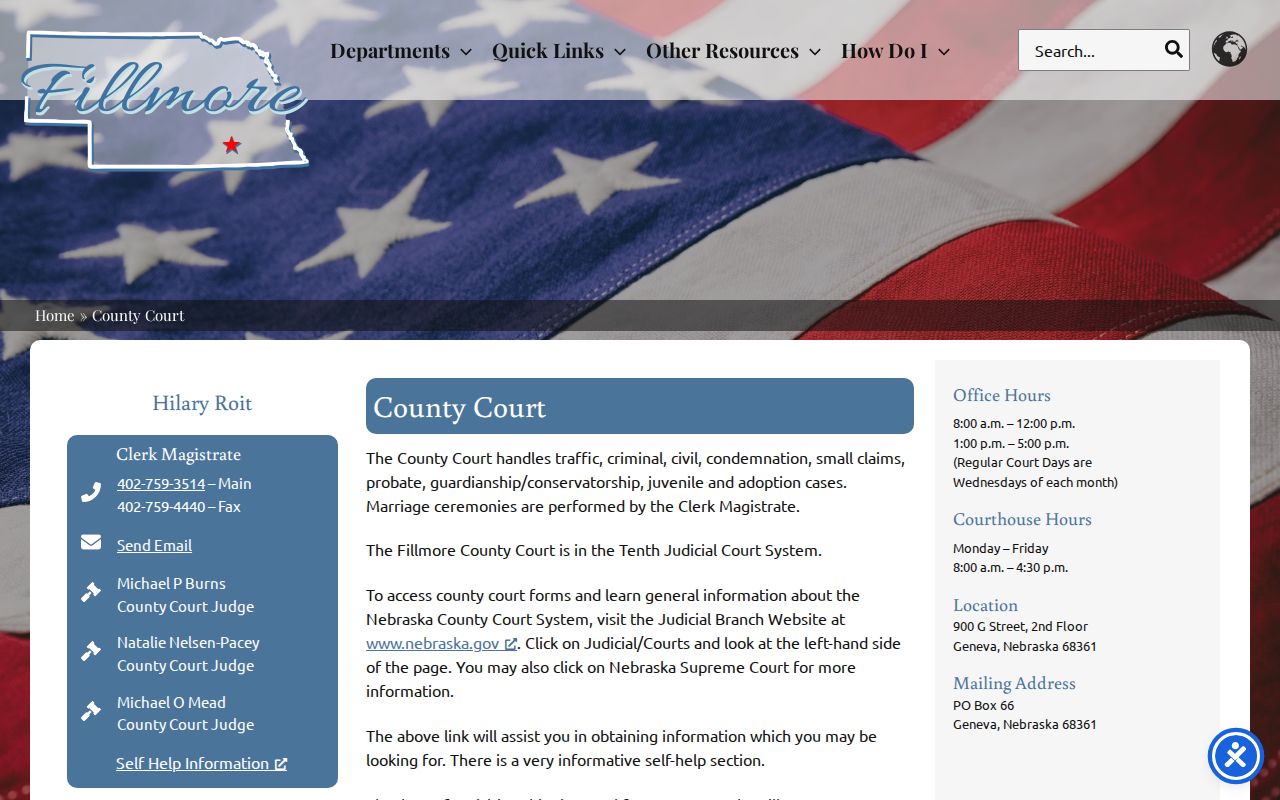
This local source is the right starting point for misdemeanor, traffic, ordinance, and felony-preliminary papers.
Fillmore County Case Record Searches
Nebraska's JUSTICE Court Case Search provides the remote statewide channel. A free public terminal is available at the courthouse. The one-time online search costs $17, returns up to 30 cases, and stays available for three calendar days. New case entries ordinarily lag about 24 hours. A broad party-name search works best at first because too many filters can hide the correct filing.
- Choose the public courthouse terminal or the one-time JUSTICE search based on whether free in-person or paid remote access fits the need.
- Search the party name with careful spelling, leaving county and year broad if the likely filing date is uncertain.
- Narrow a large result set by Fillmore County, court type, case type or subtype, filing year, judge, or attorney.
- Open the likely case and review the summary, party list, offenses, financial fields, and register of actions.
- Request the needed pleading, order, judgment, or certified copy from the County Court or District Court clerk.
| JUSTICE field | Type | Required | Search note |
|---|---|---|---|
| Party name | Text | Search basis | Begin broad and confirm identity from case context. |
| Court type | Selection | No | Separates County Court from District Court. |
| Case type or subtype | Selection | No | Narrows the kind of filing. |
| County | Selection | No | Select Fillmore for local results. |
| Year | Selection | No | Use only when the filing year is reasonably known. |
| Judge or attorney | Selection or text | No | Useful for frequent or well-known case research. |
| Judgment date or case number | Direct search | No | Subscriber detail searches cost $2. |
Fillmore County JUSTICE Access Choices
JUSTICE offers different access tiers. The courthouse kiosk is free and serves a visitor who can search in Geneva. One-time remote access costs $17 and displays no more than 30 cases, so a common name may need careful narrowing. Subscriber access costs $100 per year for as many as ten users. General list data include the party, court, case type and subtype, county, year, judge, and attorney. Opening detailed information costs $2, while linked images carry no extra fee.
The Nebraska Judicial Branch case-information page explains those search choices and current fees.
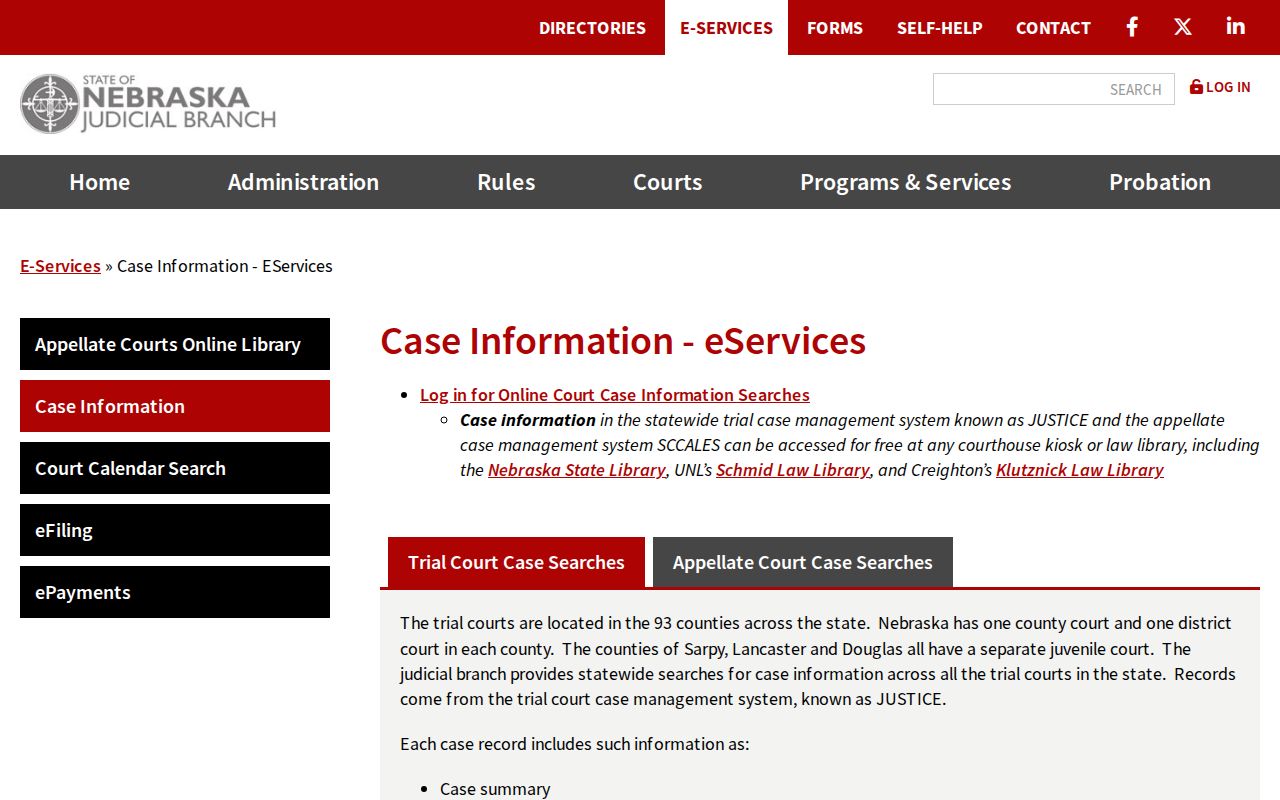
The remote portal saves travel, but the clerk remains the fallback for old, sealed, destroyed, or not-yet-digitized material.
What a Criminal Case File Contains
A Fillmore County criminal case file is organized around a prosecution, not a person's complete history. JUSTICE can show the case summary, parties and attorneys, criminal offense information, assessed and paid costs, payments, register entries, judge notes, and electronic images where available. The uniform court record can also include the complaint or information, motions, orders, verdict, and judgment. Each charge may have its own outcome, so the final entries matter more than a result-list caption.
| Case number and court | Court type, filing year, sequence, caption, subtype, and filing data. |
|---|---|
| Charging document | The complaint, information, or other filed accusation and its listed offenses. |
| Parties and counsel | Named parties, lawyers, judge assignment, and related role information. |
| Register of actions | A dated record of pleadings, hearings, filings, and orders. |
| Disposition and judgment | The result of each charge, including dismissal, acquittal, plea, or conviction. |
| Sentence and money | Sentence, conditions, costs, restitution, assessments, and recorded payments. |
Reading Fillmore County Docket Events
The register of actions is the timeline of the case. It can show when a complaint was filed, a summons or warrant issued, a hearing occurred, a motion arrived, and an order or judgment was entered. It is useful for locating the document that answers a specific question. It should not be read as a full narrative of the alleged event. That account belongs to law-enforcement and evidentiary records, some of which may be restricted.
- Arraignment
- The hearing at which the charge and plea are addressed.
- Information
- The County Attorney's charging document filed in District Court.
- Nolle prosequi
- A prosecutor's decision to decline or end a charge.
- Disposition
- The outcome assigned to a charge or case.
- Restitution
- Court-ordered payment for a qualifying loss.
- Register of actions
- The chronological list of case filings, hearings, and orders.
Review the final judgment as well as the early docket. A charge shown at filing may later be amended, dismissed, or resolved under a different count.
Criminal Case Stages in Fillmore County
A local case can start with an investigation, citation, or arrest, but the court file begins when the charge is filed. County Court handles the first appearance and complaint. For a felony, it also handles the preliminary stage before the matter proceeds to District Court on an information. The defendant is arraigned, motions and discovery follow, and the case ends through plea, trial, dismissal, or another authorized disposition. Judgment, sentence, and any appeal come after the result.
Case flow: Charges Filed › Arraignment › Pretrial › Plea or Trial › Disposition › Sentencing
The County Attorney can change the charges received from an arresting agency. That is why an intake record and a court judgment can describe the same event differently. For the broader distinction among arrest, booking, and state-history sources, consult the Fillmore County criminal history overview.
Fillmore County Certified Case Copies
When a docket entry is not enough, Judicial Branch form CC 3:29 requests the actual court document. It asks for the court and county, case number or name, document and date, delivery choice, recipient contact details, signature, and an attorney bar number when applicable. Send the request to the clerk that holds the case. District Court felony records should not be sent to the County Court counter merely because the proceedings began there.
| Copy type | Current charge |
|---|---|
| Emailed noncertified copy | Free |
| Mailed noncertified copy | $0.25 per page |
| Emailed certified copy | $1 per request |
| Mailed certified copy | $1 seal fee plus $0.25 per page |
Prepayment is required. Describe the pleading, order, or judgment closely enough for staff to locate it, rather than asking the clerk to create a new summary.
Fillmore County Adult Drug Court Records
Southeast Nebraska Adult Drug Court serves Fillmore County through assessment, treatment, testing, supervision, and structured incentives or sanctions. Successful completion can affect the disposition. The public case file may show court orders and the final result, but it does not make confidential treatment and supervision details broadly public. Search the court record for filed orders and disposition, then ask the clerk which documents are available.
This program is also a reminder that a case result may not fit a quick guilty-or-dismissed label. The register should be read across the full period of participation. If completion triggers removal under Nebraska's criminal-history law, the court and NSP systems may update on separate schedules. A stale or conflicting entry should be raised first with the office that supplied it.
Access Rules for Case Records
Nebraska court records are generally open through the clerk, public terminal, or paid JUSTICE service, but several limits apply. Sealed and destroyed records do not appear like ordinary public cases. Juvenile adjudication is not an adult conviction and follows separate confidentiality and sealing law. Personal identifiers and victim-sensitive information can be redacted. Some images or older papers may exist only through the clerk even when a case index appears online.
A missing result can also have a simpler cause. The filing may be too new for the ordinary 24-hour entry lag, the search may be too narrow, the case may have moved from County Court to District Court, or the name may differ from the spelling used in the file. Ask the correct clerk before concluding that no case exists.
Nebraska's public-record rules do not require a clerk to create a new report from court data. Request a named pleading, motion, order, judgment, or register when possible. If the case qualifies for nonconviction removal or a set-aside, confirm the order in the sentencing court first. The public court view and NSP repository can update on different schedules, so a mismatch should be traced to the office that supplied the disputed entry.
The Fillmore County Clerk of District Court is the local felony file counter.
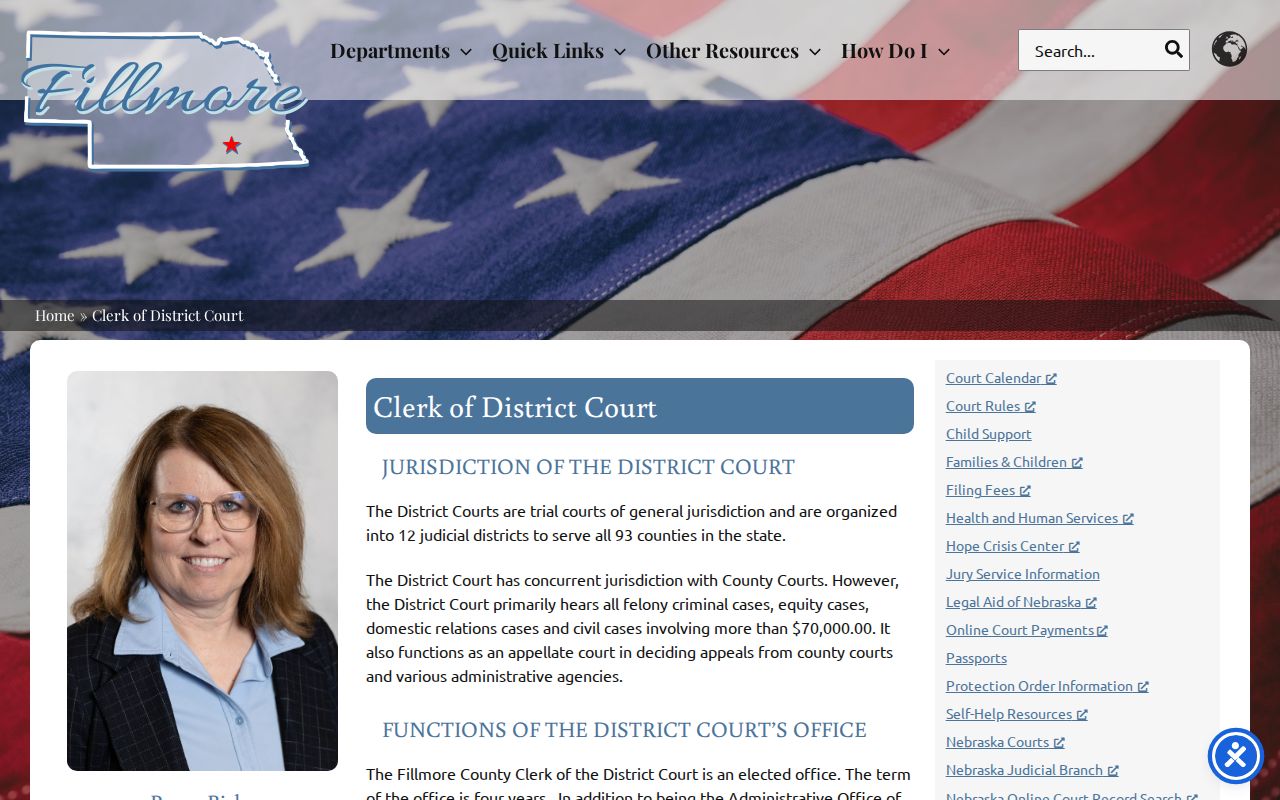
The clerk can address copy access, certification, and records that are not available through the ordinary public view.