
Exeter Criminal History Checks
An Exeter records search begins with dispatch, not an assumed local police desk. The current village website lists the village office but does not advertise a police department, marshal, report request form, or blotter. The county plan describes Fairmont’s marshal serving Exeter by interlocal agreement, and sheriff dispatch supports the county. Location alone therefore cannot show whether Fairmont or the sheriff owns a report.
Follow these steps for a record tied to Exeter.
- For an emergency, call 911; for a past event, call sheriff dispatch and ask which agency responded.
- Request the incident or arrest report from the confirmed Fairmont marshal or sheriff custodian.
- Contact the Exeter Village Clerk only for ordinances, minutes, resolutions, and other administrative material.
- Use JUSTICE or the Fillmore County court clerks for a filed citation or criminal case.
- Use the NSP RAP for fingerprint-supported statewide Nebraska arrest and disposition history.
Who Holds Exeter Police Records
The honest answer depends on the call. The current Exeter local-government page provides no active police counter or report channel. Older Nebraska Crime Commission tables retain an “Exeter PD” label, but those historical listings do not establish a current office. The county comprehensive plan instead describes an interlocal service arrangement with Fairmont’s marshal.
The official local-government page is the best current starting point for Exeter administrative contacts.
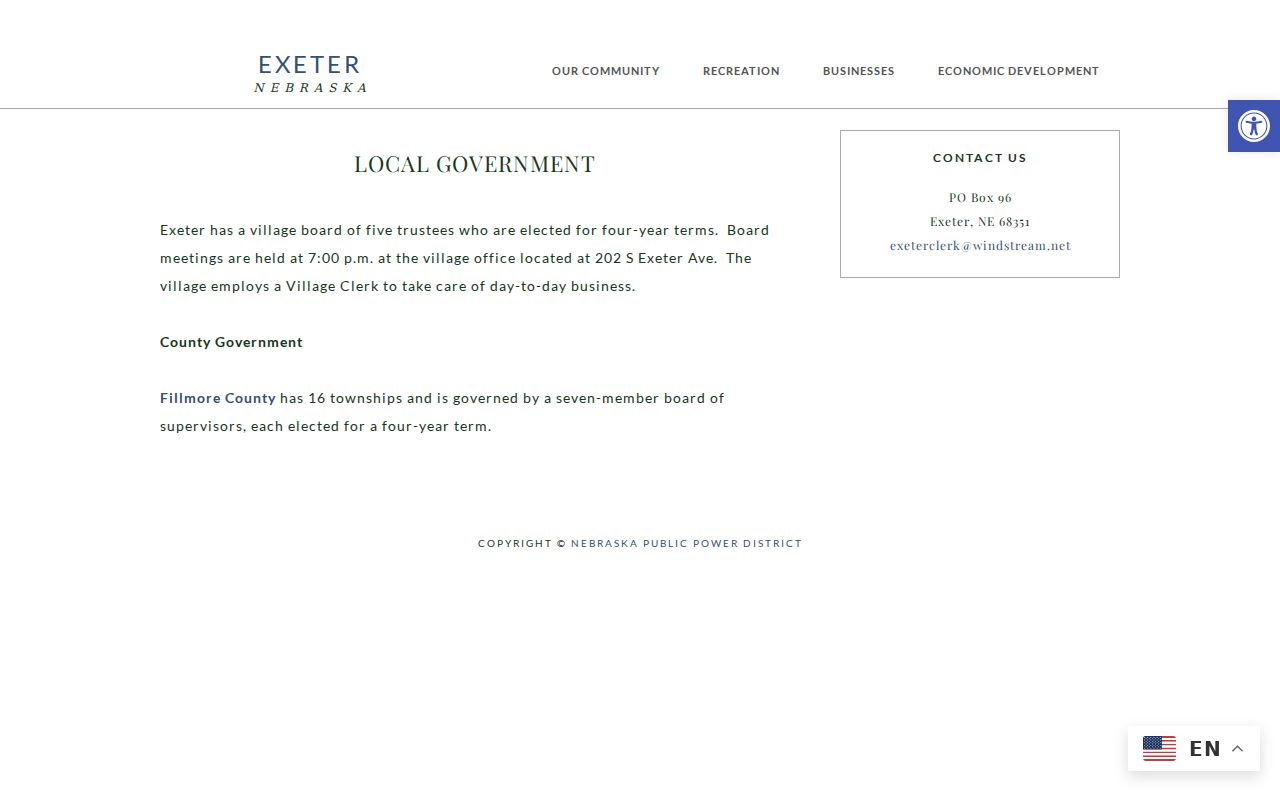
The screenshot confirms the village office route while showing why law-enforcement ownership must be confirmed elsewhere.
Call the Fillmore County Sheriff at 402-759-4441 and ask which agency answered. If Fairmont’s marshal wrote the report, request it there. If a deputy handled or took ownership, request it from the sheriff. This small step is more reliable than sending the same broad request to several offices.
Records at the Exeter Police Department
No current Exeter Police Department is listed by the village, so there is no verified Exeter police records unit, counter, phone, online form, search field set, fee schedule, or app. An older agency name in a state data table must not be turned into a present office. For a recent incident, use sheriff dispatch to locate the actual responding agency.
Exeter Village administrative records begin with the clerk at 202 S Exeter Avenue, PO Box 96, Exeter, NE 68351. The office number is 402-266-3051, and the official site lists exeterclerk@windstream.net. The clerk is the right source for village minutes, ordinances, resolutions, and ordinary government papers. No official form exposed requester identification, incident fields, certification options, copy media, payment method, fee, delivery choice, or turnaround.
Note: A missing Exeter police page is not proof that no officer responded or that no report was created.
Finding an Exeter Report Owner
Start with the event date, time, exact place, type of call, and any officer or agency name shown on a citation. Ask dispatch whether Fairmont or the sheriff created the primary report. An NSP highway response would instead belong to the State Patrol. The office that authored the record applies its own search and redaction process.
A narrow request should identify the report, not demand a newly compiled history. Include an incident or case number if known and specify the parts sought, such as the incident narrative, citation, arrest portion, or releasable booking detail. Nebraska public-record law does not require an office to create a report that does not exist. Juvenile, victim-sensitive, personal-identifier, security, medical, and active investigative content may be withheld or redacted.
Booking and Arrest Records in Exeter
Exeter has no official village jail, booking search, arrest log, or custody portal. When an Exeter arrest occurs, county corrections or another boarding facility may hold the person. Call sheriff dispatch for present custody location, received charges, bond or holds if releasable, and release or transfer status. Do not assume the person remains in Fillmore County solely because the arrest occurred in Exeter.
The NDCS incarceration search covers state commitments, not fresh Exeter bookings. JUSTICE is a court case system and normally has an entry lag. It can show filed charges and register events after a case begins, but it cannot confirm real-time custody. The arresting agency report, jail intake entry, court file, and NSP RAP are separate records made at different stages.
Exeter Custody Record Route
The lack of an Exeter jail page can mislead a searcher into thinking no booking occurred. County records document the use of out-of-county prisoner boarding, and the historic courthouse jail has limited space. Dispatch remains the practical source for the facility of physical confinement. A receiving jail may hold live custody facts while the arresting agency keeps the report and transport record.
Ask specific questions: Is the person currently held? Which facility has physical custody? What booking date or number is releasable? What charges or holds were received? Was the person released or transferred? Answers can change quickly. A docket entry about bond or a warrant is not a substitute for direct custody confirmation.
The Exeter Municipal Court File
Exeter has no municipal court. Even a village ordinance prosecution is filed in Fillmore County Court in Geneva. That court also handles traffic cases, nearly all misdemeanors, and felony preliminary proceedings. Filed felonies move to District Court after the preliminary stage. Search under the county court structure rather than an imagined Exeter court name.
| Court Name | Fillmore County Court; no Exeter Municipal Court |
|---|---|
| Case Types Heard | Exeter ordinance matters, traffic, misdemeanors, and felony preliminary proceedings |
| Case Lookup Channel | JUSTICE, the free courthouse kiosk, or the County Court clerk |
| What the Docket Shows | Case summary, parties, offenses, financial entries, register events, orders, and available images |
| Copies & Fees | Free emailed noncertified copy; $0.25 per mailed page; $1 certification per request plus mailed-page charges |
County Court is at 900 G Street and can be reached at 402-759-3514. The District Court clerk handles felony files at 402-759-3811. The court record shows what was filed and how it ended, which may differ from an intake charge.
Exeter JUSTICE Case Lookup
The JUSTICE Court Case Search is the remote route for an Exeter citation or filed criminal case. The one-time search costs $17, returns up to 30 cases, and remains accessible for three calendar days. New entries ordinarily lag about 24 hours. Use a party name first, then narrow to Fillmore County, court type, or filing year if necessary.
A free public terminal is available at the courthouse. Neither option proves identity from a name alone. Compare the court, year, subtype, parties, offense entries, and chronological register. Sealed, destroyed, old, and newly filed material may be missing from an ordinary result. JUSTICE also does not replace direct confirmation of a current warrant or custody status.
How Exeter Records Reach the County
An Exeter event first produces a report at the responding agency, whether that is Fairmont’s marshal, a sheriff deputy, or NSP. A jail or boarding facility creates the custody record. The Fillmore County Attorney decides whether and what to file. County Court handles ordinance, traffic, misdemeanor, and preliminary felony stages; District Court maintains a filed felony. Fingerprint-supported arrest and reported disposition information may later reach the state repository.
Record flow: Confirmed Fairmont marshal, Fillmore County Sheriff, or NSP response › Fillmore County Court or District Court › Nebraska State Patrol Criminal Identification Division
The $30 NSP RAP is a statewide identity history, not an Exeter incident report. It may omit nonfingerprinted events, events outside Nebraska, reporting gaps, or matters removed from ordinary public view. Use the report for the response, the court file for prosecution, and RAP for repository history.
Exeter records can appear at different times. The responding agency writes first, custody data changes quickly, the prosecutor files later, and NSP waits for fingerprint and court reporting. Check the date and custodian before treating two official results as contradictory.
Exeter Record Data Gaps
Older official reports retain an Exeter PD agency label but mark it as nonreporting. FBI crime reporting is voluntary. A blank row, missing year, or zero-shaped output can mean no submission rather than no police activity. It cannot support a claim that Exeter had no stops, arrests, or offenses.
Current service arrangements also make a city-only trend hard to read. Fairmont marshal activity and sheriff activity may sit under their respective agencies. Use the correct agency and a complete reporting year, and disclose participation limits. For an individual event, direct report ownership and the filed case matter far more than an incomplete statistical series.
An Exeter search should record the agency name exactly as shown in the source and note whether the source describes a current office or only a legacy label. The date matters. A historical Exeter PD entry cannot establish who answers calls now, while a present village website that omits a police desk does not prove no law-enforcement service exists. Dispatch confirmation resolves that gap for a specific incident, and the court file resolves what was actually prosecuted.
Exeter Record Access Rules
Nebraska’s public-record law covers Exeter village records, but the right is not a promise that every field is open. The village clerk handles Exeter administrative material. Law enforcement handles its own reports, and court clerks handle filed cases. A difficult request should receive access or a written response under the four-business-day framework, with an explanation, good-faith completion estimate, and cost estimate when needed.
Key Statutes:
Neb. Rev. Stat. §84-712 states the inspection and copy right.
Neb. Rev. Stat. §84-712.03 governs access responses and time estimates.
Neb. Rev. Stat. §84-712.05 protects listed investigative and sensitive interests.
Neb. Rev. Stat. §29-3523 limits ordinary release of defined criminal-history outcomes.
Exeter Railroad Record Context
Exeter’s official history traces settlement to 1870 under the Homestead Act and incorporation to 1879. Burlington’s railroad shaped both the town site and a westward alphabetical run of station names: Crete, Dorchester, Exeter, Fairmont, Grafton, Hastings, Inland, Juniata, Kenesaw, and Lowell. Exeter marked its centennial in 1979.
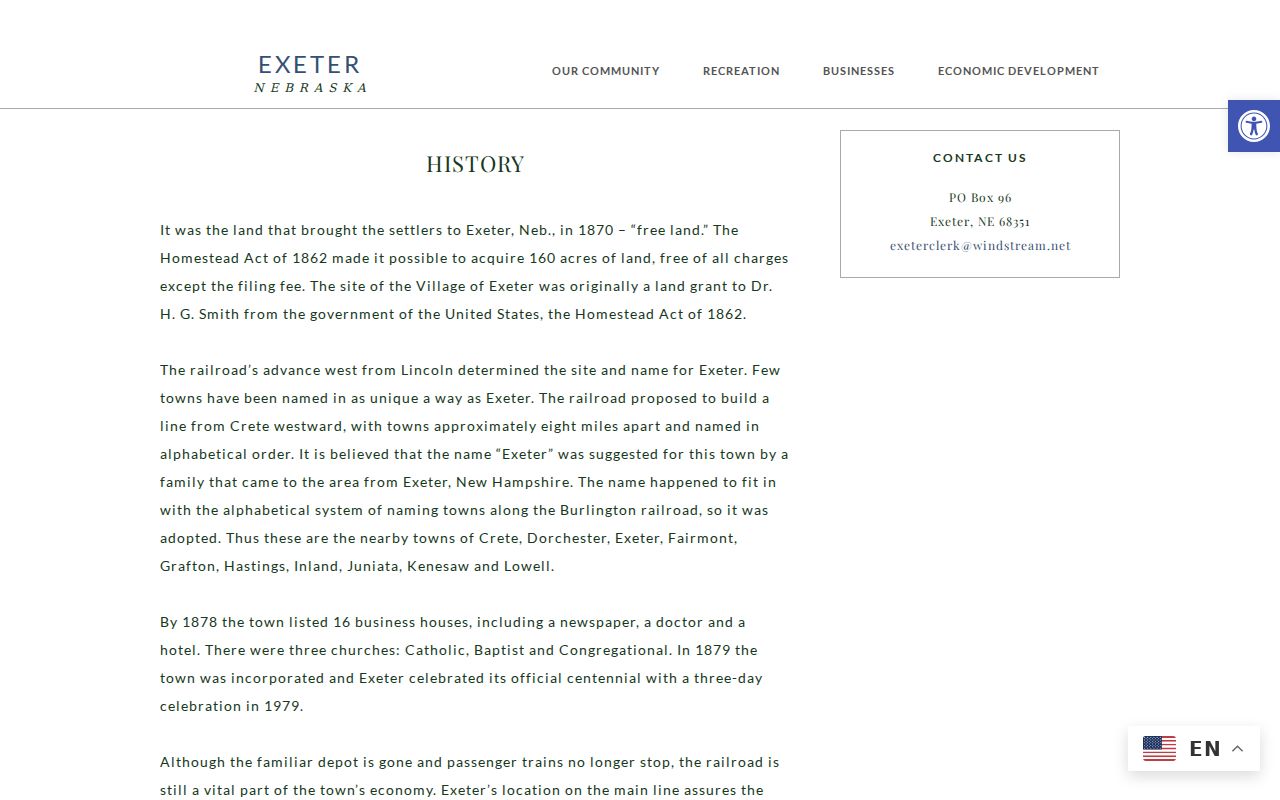
The historical page supplies safe civic context while remaining separate from modern Exeter criminal files.
That rail history also explains Exeter’s regional orientation. Passenger service ended, but the main line remains, and county justice records now route to Geneva rather than a village court.
Exeter Highway Record Geography
The official Exeter homepage places the village on U.S. Highway 6 and describes its paved, tree-lined community setting, parks, and school. This small-village geography helps explain why the local-government office is visible while criminal record custody rests with shared law-enforcement and county systems.
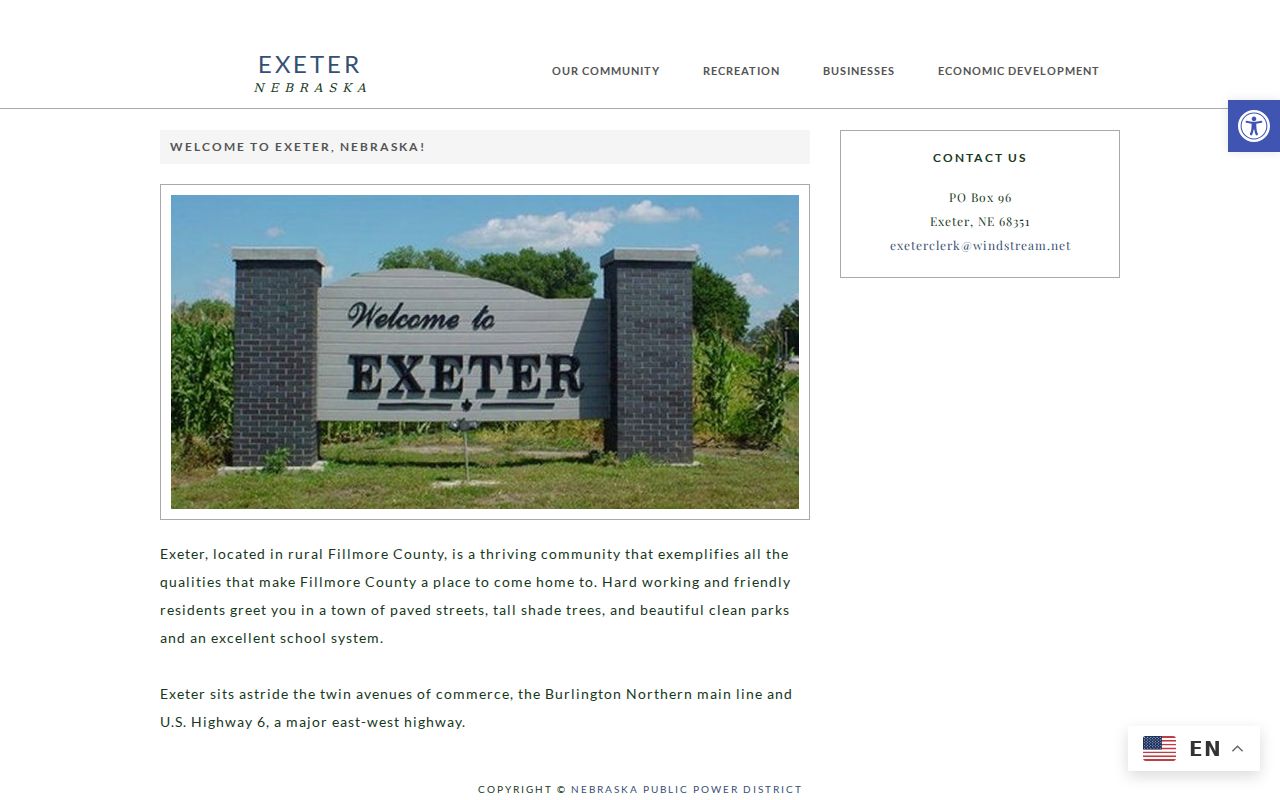
The community view reinforces why a current Exeter record search must follow the responding agency out to county dispatch and courts.
Distance does not change custodianship. Village ordinances and administrative records stay with Exeter. A Fairmont marshal or sheriff report stays with that agency. Court and custody questions lead to Geneva, while NSP holds the statewide fingerprint repository.
An official state community guide places Exeter about 22 miles from Interstate 80 and roughly 23 minutes east of U.S. Highway 81. Those routes may shape which agency answers a highway call, but they do not change where the resulting Exeter record belongs. Confirm the responding officer through dispatch, then follow that agency to its report. Use the Exeter clerk for village papers and the Fillmore County courts for the filed case.