
Fillmore County Criminal History Checks
Begin with the kind of fact you need. A filed prosecution belongs in Nebraska's JUSTICE Court Case Search or at the proper court counter. An incident report, recent arrest, local jail status, or warrant question begins with the Fillmore County Sheriff's Office or the agency that made the record. A statewide identity history comes from the Nebraska State Patrol Criminal Identification Division. The NDCS locator answers a narrower question about state imprisonment. It is not a Fillmore County jail roster.
Gather the full legal name, date of birth when lawfully available, likely spelling variants, incident date, and a case or report number if known. Then work from the narrow local source toward the broader state source:
- Search JUSTICE for a filed case, using a party name before adding court, county, type, or year limits.
- Open the likely case and compare its caption, offenses, filing data, and register of actions.
- Ask County Court for misdemeanor, traffic, ordinance, or felony-preliminary papers, and District Court for felony files.
- Call the sheriff for incident, booking, custody, or current warrant information that a court docket cannot confirm live.
- Order an NSP RAP when fingerprint-supported adult arrest and disposition history across Nebraska is the actual goal.
Four Fillmore County Record Systems
A single Fillmore County arrest can create four records. The responding agency writes the incident or arrest report. Corrections staff create an intake and custody file. The County Attorney's filed charge produces a County Court or District Court case. If fingerprints and later dispositions reach NSP, the event can enter the Nebraska RAP. Each source answers a different question, and each may update on a different day.
| Source | Best question | Main limit |
|---|---|---|
| Sheriff or marshal | What did the agency report? | Active and sensitive details may be withheld. |
| Jail or boarding facility | Where is the person held now? | Custody can change quickly. |
| JUSTICE and court clerk | What charge was filed and how did it end? | Entries ordinarily lag about 24 hours. |
| NSP RAP | What fingerprint-supported Nebraska cycle is public? | It is not a full national history. |
When two official records differ, compare their creation dates and custodians before treating either as wrong.
Official Background Checks in Nebraska
The Nebraska State Patrol RAP service provides the official public state history. A public request costs $30 per person and searches Nebraska fingerprint-supported adult arrests and reported outcomes. It can miss an arrest if prints were not taken or sent, an out-of-state event, or a disposition that has not reached the repository. A public response also follows the restrictions in Nebraska law. A more complete release of restricted material generally needs the subject's notarized release to a named recipient unless another statutory exception applies.
The official NSP explanation is shown in the captured source below.
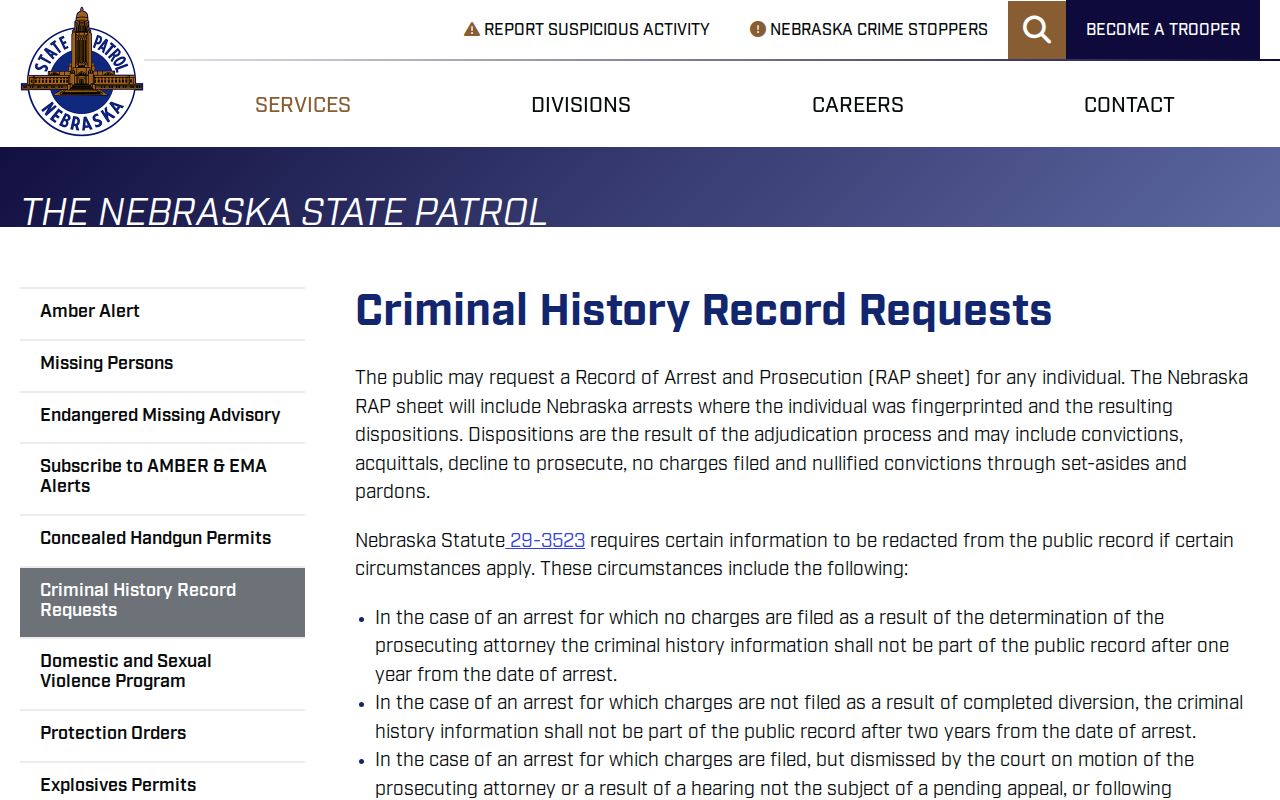
The source makes clear why a RAP and a Fillmore County court file should be checked separately.
Fillmore County RAP Search Fields
The online RAP request moves through requestor information, person of interest, payment, and results. Required identity fields help distinguish people with similar names. The first three letters of the first and last names take part in matching. An optional Social Security number, driver license, and residence can improve the request, but a wrong name, birth date, or Social Security number cannot be corrected after submission. A new paid request is then required.
| Field | Required | Use |
|---|---|---|
| Requestor name, address, email | Yes | Contact and delivery |
| Person's first and last name | Yes | Core name match |
| Date of birth | Yes | Identity criterion |
| Sex and race | Yes | Unknown may be selected |
| SSN, license, residence | No | Optional matching detail |
| Card payment | Yes | Nonrefundable $30 fee |
A no-record response may download at once. Technician research can take three business days, and the receipt can retrieve the result for 14 days.
Kinds of Fillmore County Criminal Records
Fillmore County criminal records are defined by who created them. An incident report describes the alleged event and the responding officer's work. A booking file records intake, received charges, holds, bond, transfer, and release. A charging complaint or information states what the prosecutor chose to allege. Court records track pleadings, hearings, orders, judgment, sentence, and money fields. The RAP groups fingerprint-supported Nebraska cycles by identity.
- Warrant record: an issuing court creates it, while law enforcement serves and tracks it.
- Probation record: court orders are public in the case, but supervision notes are not wholesale public files.
- Parole and corrections record: NDCS and the Board of Parole hold state custody and release material.
- Registry record: NSP publishes a statutory public subset through the Nebraska Sex Offender Registry.
- Juvenile record: it follows separate confidentiality and sealing law and is not an adult public RAP.
Fillmore County Courthouse Record Hub
The official Fillmore County service hub reflects how many record custodians remain concentrated at 900 G Street in Geneva. The courthouse holds the sheriff and jail, County Court on the second floor, the District Court clerk, and other county offices. County Court handles misdemeanors, traffic, ordinances, and felony preliminary matters. District Court holds filed felony cases. The County Clerk is the practical fallback for a general county public-record request.
The county's official site appears in the source image below.
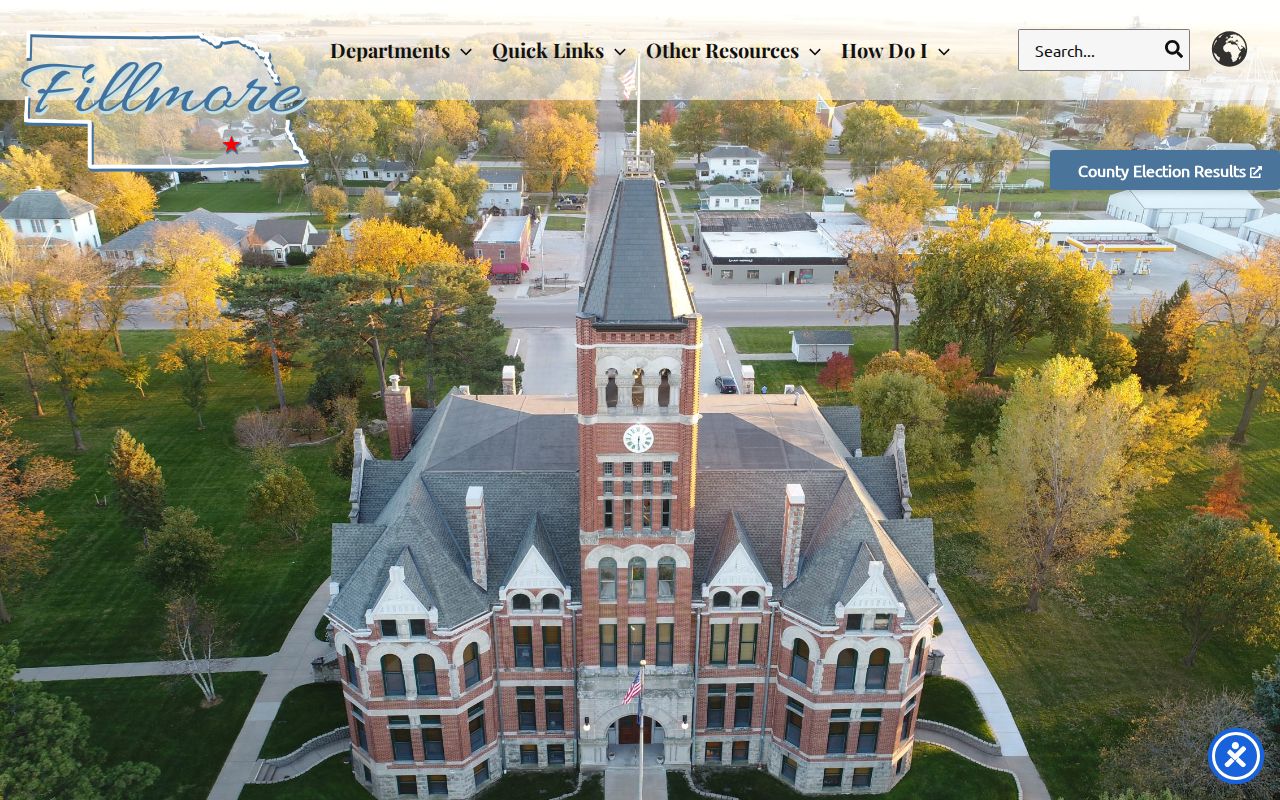
The shared address does not make the offices interchangeable. Ask the sheriff for law-enforcement records and the proper clerk for a court file.
The building itself helps explain this close records geography. Construction began in 1893, and the courthouse was completed in 1894 from a design by George E. McDonald. Its clock arrived in 1909. County records work still takes place around the same landmark, even though modern case, RAP, and corrections systems now provide remote routes. County Court keeps split counter hours from 8:00 a.m. to noon and 1:00 to 5:00 p.m.; the sheriff's public office remains open through lunch from 8:00 a.m. to 4:30 p.m. Calling the intended office first avoids a trip to the wrong counter.
Fillmore County Criminal Records: What They Contain
A record's fields reveal its purpose. RAP identification can include legal and prior names, birth date, sex, race, and repository identifiers, followed by fingerprint-supported arrest cycles and reported dispositions. JUSTICE instead organizes data by case. Booking data focuses on intake and custody, though Fillmore County publishes no roster from which an exact public field set can be confirmed.
| Name and identifiers | Legal or prior names, birth data, and source-specific identity keys. |
|---|---|
| Arrest or booking | Date, agency, received charge, intake identifier, bond, location, transfer, or release when disclosed. |
| Filed charges | Complaint or information, offense description, statute, and filing data. |
| Case activity | Parties, lawyers, hearings, motions, orders, judge notes, and chronological register entries. |
| Outcome | Dismissal, acquittal, plea, conviction, judgment, sentence, costs, restitution, and payments as applicable. |
| Supervision | Public court terms or state custody data, not confidential case notes or treatment files. |
Fillmore County Jail Record Limits
There is no official Fillmore County online booking log, inmate roster, arrest blotter, or public profile search. The sheriff's county page links to the NDCS Incarceration Record Search, but that tool covers state commitments. It cannot establish whether someone is in the courthouse jail, was released, or was transferred to a boarding facility. The older official capacity figure is eight and should not be read as a current rated-capacity certification.
The NDCS state-prison locator is pictured below.
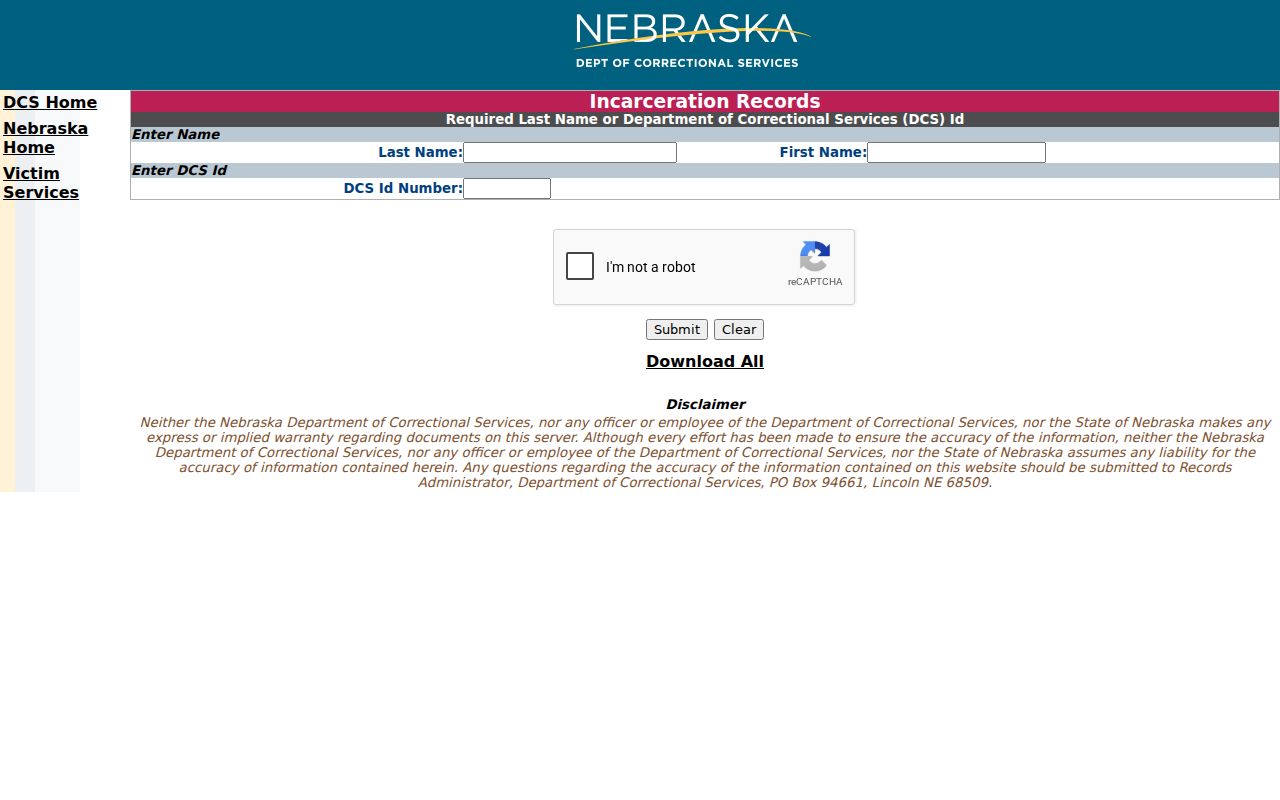
For current local custody, call Fillmore County sheriff dispatch at 402-759-4441 and ask whether another facility holds the person.
That confirmation matters in Fillmore County because official 2025 claims record prisoner-boarding payments to the Hamilton County Sheriff and NDCS. Recent county work also replaced cell lights, remodeled the kitchen, ordered toilets, and added Guardian RFID tools for security and cell checks. Those improvements describe jail operations, not a public inmate portal. A person arrested here may be held elsewhere, while the local sheriff still retains the arrest or transfer record. Bond and release instructions should come from the jail or issuing court because no local vendor rules or posting method were published.
Nebraska Public Access Laws
Nebraska law starts with a right to inspect and copy public records, but access is not the same as unrestricted release of every field. The correct custodian may redact personal identifiers, juvenile material, victim-sensitive facts, sealed information, or investigative material whose disclosure would cause a listed harm. A focused request should name the incident, date range, office, and desired format. Under the response rule, the custodian generally provides access or a written response within four business days, while a difficult request receives an explanation and a good-faith time and cost estimate.
Key Nebraska laws:
§84-712 establishes the inspection and copy baseline.
§84-712.03 sets the response and estimate process.
§84-712.05 lists discretionary exemptions.
§29-3523 governs restricted and removed criminal-history information.
§29-2264 provides Nebraska's conviction set-aside remedy.
Fillmore County Warrant Record Fallback
No official Fillmore County warrant search or most-wanted list was located. For a suspected active warrant, call the sheriff at 402-759-4441 and contact the issuing court. County Court at 402-759-3514 handles misdemeanor, traffic, ordinance, and related bench matters. District Court at 402-759-3811 handles felony matters. JUSTICE can supply a secondary clue from the register of actions, but its entry lag means it cannot confirm live warrant status.
Bench warrants often follow a failure to appear or comply. Arrest warrants authorize custody based on probable cause, while search warrants authorize a search of a place or property and may remain sealed. A person resolving their own warrant should get the exact case, charge, and bond or appearance instructions from the issuer. Reconfirm after a hearing or payment because clearance may not appear in every system at once.
Restricted, Sealed & Expunged Records
Nebraska's remedies have different effects. A set-aside under §29-2264 is filed in the sentencing court after a qualifying completed sentence. The judge weighs conduct after sentence, future risk, and public welfare. An order nullifies the conviction and removes specified disabilities, but it does not erase the file. The case can remain visible with a set-aside status and can retain certain later legal uses.
Section 29-3523 removes defined nonconviction outcomes from ordinary public criminal-history access. No charges after one year and completed diversion with no charges after two years are key schedules. A qualifying dismissal, acquittal, deferred-judgment dismissal, or successful problem-solving court completion can be removed after notice or order. True expungement is narrow and requires proof that law-enforcement error caused the arrest. In Fillmore County, use the sentencing County Court or District Court and the Judicial Branch forms, then check both JUSTICE and an NSP self record after relief.
Fillmore County Supervision Records
Fillmore County probation is part of Nebraska's state-run judicial system in Probation District 1. The local office is in Fillmore County East, the reused hospital and clinic at 1320 G Street in Geneva. Court sentencing and revocation entries can appear in JUSTICE. Detailed presentence reports, treatment facts, psychological material, supervision notes, and violation investigations are not wholesale public records.
The official Fillmore probation office page is captured here.
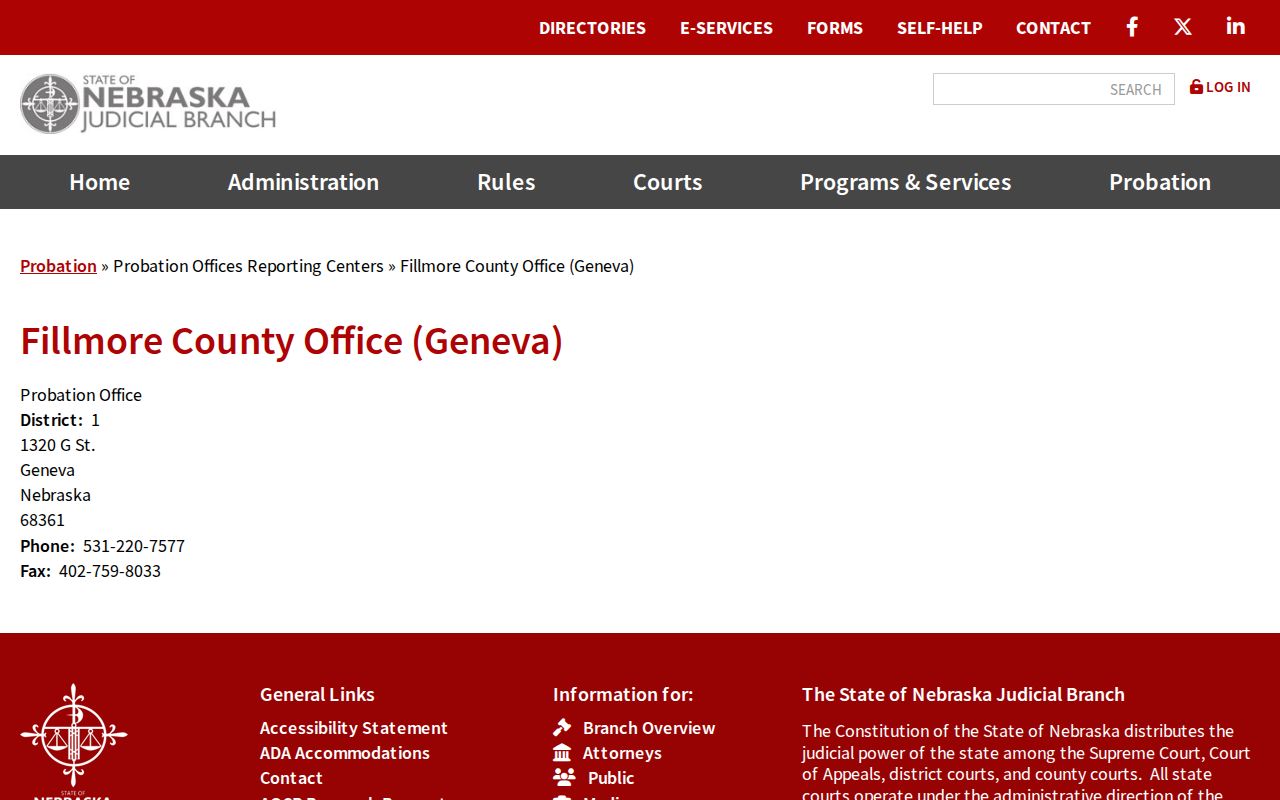
Probation violations return to the sentencing court. Parole is different: the Nebraska Board of Parole makes release and revocation decisions, while NDCS supervises parolees.
Fillmore County Court Record Terms
Short docket labels can change how a result is read. These terms help separate a pending allegation from a final Fillmore County outcome.
- Complaint
- The initial sworn charging allegation, often used in County Court.
- Information
- The prosecutor's charging document for a felony in District Court.
- Register of actions
- The chronological docket of filings, hearings, and court orders.
- Disposition
- The result of a charge, such as dismissal, acquittal, plea, or conviction.
- Nolle prosequi
- A prosecutor's decision to end or decline a charge.
- Set aside
- A Nebraska order that nullifies a conviction without erasing the record.
Read the charging document and final judgment together. An intake label can change before filing, and one case may contain several charges with different results.
Federal Records Beyond Fillmore County
Federal cases and custody sit outside Fillmore County's local systems. PACER provides federal docket access, while the Bureau of Prisons locator covers federal imprisonment. Neither belongs in a Nebraska RAP or a county jail search. A BOP result may show a name, register number, age, race, sex, release date, and location. A no-custody result does not rule out local custody, another agency, or supervision.
The official Bureau of Prisons locator appears below.
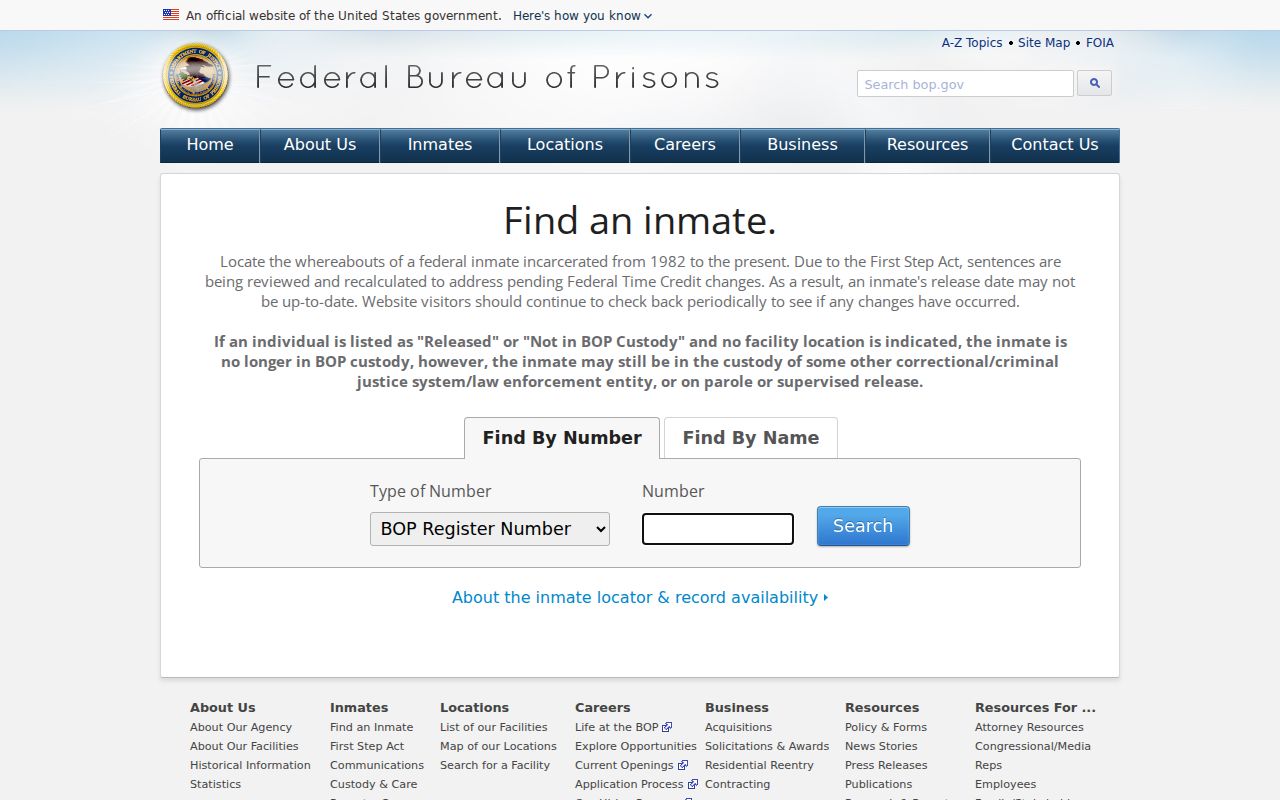
Use the federal layer only when the case or sentence is federal, then confirm the docket through the U.S. District Court for Nebraska.
City-by-City Criminal Records in Fillmore County
Record ownership changes across Fillmore County. Geneva contracts law enforcement to the sheriff, so a Geneva incident report generally starts at 900 G Street rather than City Hall. Fairmont has a one-person marshal with sheriff backup, and the report belongs to the agency that created it. Exeter lists no current police counter, so sheriff dispatch should identify whether the marshal or a deputy owns the report. Nebraska does not operate separate municipal courts here; city ordinance cases route through County Court.
Geneva Record Check
Sheriff-contracted policing and county-seat court access.
Fairmont Record Check
Village marshal records with sheriff backup.
Exeter Record Check
Agency ownership confirmation before a report request.
For any of the three cities, a filed court case still routes to the County Court or District Court clerk in Geneva. City clerks remain the right source for municipal administrative material such as ordinances, minutes, and resolutions, but not for a sheriff-created criminal incident report.